
Table of Contents
Concrete Repair and Waterproofing Essentials in Oakland, California
Concrete repair in Oakland must contend with the relentless combination of coastal fog, winter rains, and high humidity that accelerates deterioration. According to Simpson Gumpertz & Heger (SGH), these environmental loads, along with seismic movement, demand proactive maintenance. In Oakland, failing to address cracks and moisture intrusion can compromise structural integrity and lead to costly damage over time.
For lasting concrete repair in Oakland, professionals rely on epoxy injection and wall waterproofing. Epoxy injection concrete repair bonds cracks with a high-strength resin, preventing water penetration and restoring structural strength. In the Bay Area, waterproofing concrete walls is non-negotiable to stop mold, efflorescence, and freeze-thaw damage. Together, these interventions safeguard both above- and below-grade concrete surfaces. These measures also limit corrosion of embedded steel and extend overall structural service life significantly.
ARC Services of the Bay Area brings decades of experience with Oakland’s building codes, permit processes, and seismic retrofit coordination. That is why working with a trusted general contractor waterproofing bay area is the best way to guarantee long-lasting results. Contact us today for a personalized assessment and code-compliant repair plan.
Understanding Concrete Repair and Waterproofing Needs in Oakland, California
Oakland’s location in the seismically active Bay Area creates unique challenges for commercial and residential concrete structures. From hairline cracks caused by minor ground movement to moisture intrusion through aging foundations, understanding regional deterioration patterns is essential. For property owners, effective concrete repair in Oakland demands awareness of local environmental and structural factors to protect building value and safety.
Common Concrete Issues in Oakland Structures
Many of the concrete problems seen in Oakland arise from a combination of seismic activity, coastal climate, and aging building stock. The most frequent issues include:
- Spalling from rebar corrosion – Buildings constructed before 1970 often have inadequate concrete cover over reinforcing steel. When moisture and oxygen reach the rebar, corrosion expands the metal and causes the concrete to crack and flake away.
- Efflorescence – A white, powdery residue on concrete surfaces indicates moisture migration. While unsightly, it typically points to insufficient waterproofing rather than structural failure.
- Seismic cracking – Even minor tremors can initiate hairline fractures that, over time, widen and allow water to penetrate deeper layers.
- Freeze-thaw damage – Though infrequent, periodic freeze-thaw cycles can exploit existing cracks and accelerate deterioration, especially on north-facing walls.
- Water intrusion from coastal fog and rain – Persistent moisture from the Bay Area climate saturates concrete pores, driving ongoing deterioration if left unchecked.
Recognizing these signs early helps property owners determine when to seek further assessment and how to prioritize concrete repair in Oakland.
Evaluating Structural vs. Cosmetic Damage
Not every crack signals a serious problem. Fine, non-moving cracks — usually 1/16 inch or less — are typically surface shrinkage or seasonal expansion with no structural consequence. However, cracks wider than 1/8 inch, especially those accompanied by vertical displacement, stair-step patterns in masonry, or rust staining, often point to settlement, lateral loading, or corroding reinforcement. Active widening is a red flag that demands immediate attention.
For non-moving cracks that do not pose an immediate structural risk, epoxy injection concrete repair can restore integrity by completely filling the fissure and bonding the concrete. This technique is widely used when cracks are stable and access is feasible.
For cracks wider than ⅛ inch or signs of settlement, property owners should consider structural repair services Bay Area to prevent further deterioration. A professional evaluation that incorporates core sampling, ultrasonic testing, or ground-penetrating radar can definitively map the extent of damage and guide targeted repairs.
The Role of Waterproofing in Concrete Durability
Moisture is the primary enemy of concrete longevity. In Oakland’s climate, with persistent coastal fog, winter rains, and occasional de-icing salts, waterproofing concrete walls in the Bay Area becomes a critical protective measure. Elastomeric deck coatings and cementitious below-grade systems form barriers that prevent water, chlorides, and other contaminants from reaching reinforcing steel. By blocking freeze-thaw cycling and chemical attack, effective waterproofing can extend the functional life of a concrete structure by 10 to 15 years.
Effective Bay Area waterproofing solutions also address drainage around hill-slope properties — common in neighborhoods like Montclair and Rockridge — where runoff can saturate foundation soils and worsen water intrusion. Pairing proper surface coatings with subsurface drainage ensures comprehensive moisture protection for Bay Area concrete, reducing the risk of spalling and internal corrosion. Investing in Oakland concrete restoration that prioritizes waterproofing preserves structural integrity and avoids costly future repairs.
In the next section, we explore specific repair techniques for Oakland concrete, including epoxy injection and waterproofing systems.
Key Highlights of Expert Concrete Repair for Oakland Properties
Professional concrete repair in Oakland addresses more than visible cracks–it safeguards a building’s long-term performance, financial value, and occupant safety. For Bay Area property owners managing older commercial structures or multi-unit buildings, expert intervention turns reactive emergency spending into proactive asset protection. ARC – Architectural Restoration Waterproofing brings this approach to every assessment, diagnosing the conditions that drive deterioration before recommending repairs. The following highlights show how targeted concrete restoration delivers measurable outcomes across the typical lifecycle of Oakland properties.
Extending Lifespan and Preventing Recurrence
Superficial patching rarely stops concrete from degrading again because it ignores the forces that caused the failure. Professional evaluation traces damage to its source–often rebar corrosion triggered by coastal salt air or moisture intrusion through unsealed cracks. In Oakland’s older apartment buildings, basement walls frequently suffer from water ingress that weakens foundations and invites mold. Our team combines structural repair with stucco and concrete restoration to close entry points on both wall assembly types, preventing moisture from reaching embedded steel. Applying waterproofing concrete walls Bay Area properties rely on creates a barrier that interrupts the cycle of wetting and drying, effectively extending the service life of the entire assembly. By treating the root cause rather than the symptom, expert restoration avoids repeat failures and preserves the original building fabric for decades.
Cost Savings Through Early Intervention
A hairline crack in a commercial parking slab may seem cosmetic until seasonal rain penetrates the surface and begins eroding the subgrade. Once the void expands, the slab loses support and eventually requires full replacement–an expense that far exceeds the cost of timely intervention. Using epoxy injection concrete repair, technicians can fill and bond narrow fissures before water and freeze-thaw cycles, even mild ones common in Oakland winters, worsen the damage. For multi-unit property owners, the financial logic is straightforward: fixing a localized crack with injection costs a fraction of tearing out and pouring a new slab section, and it avoids the tenant disruption that accompanies major construction. Industry insights from experienced professionals confirm that early repairs preserve structural continuity while protecting rental income and property valuation. Deferring maintenance, in contrast, transforms inexpensive fissures into capital-intensive failures that strain operating budgets.
Enhanced Safety and Code Compliance
Concrete restoration in Oakland must align with the California Building Code Title 24, which enforces seismic provisions stricter than national standards. Expert repairs incorporate seismic retrofitting techniques that tie existing walls and foundations together, improving the building’s ability to withstand the lateral forces the Bay Area’s earthquake risk demands. This level of compliance does more than meet legal requirements–it offers liability protection for owners who can demonstrate they have maintained their properties to code. Throughout the project, adherence to OSHA safety protocols protects both the work crew and the building’s occupants from hazards associated with heavy demolition and material handling. In a region where structural resilience is non-negotiable, code-compliant concrete restoration provides the confidence that comes from knowing the building has been reinforced according to the most rigorous standards in the country. These measures collectively ensure that safety and regulatory alignment are built into every repair.
How Concrete Repair and Waterproofing Works in the San Francisco Bay Area
To address concrete deterioration and waterproofing failures typical of the region, a systematic three-stage process is used across the Bay Area. Buildings in Oakland, San Francisco, and surrounding communities face moisture intrusion from persistent fog and rain, along with subtle but ongoing seismic movement, making a thorough approach essential for durable concrete repair in Oakland and beyond.
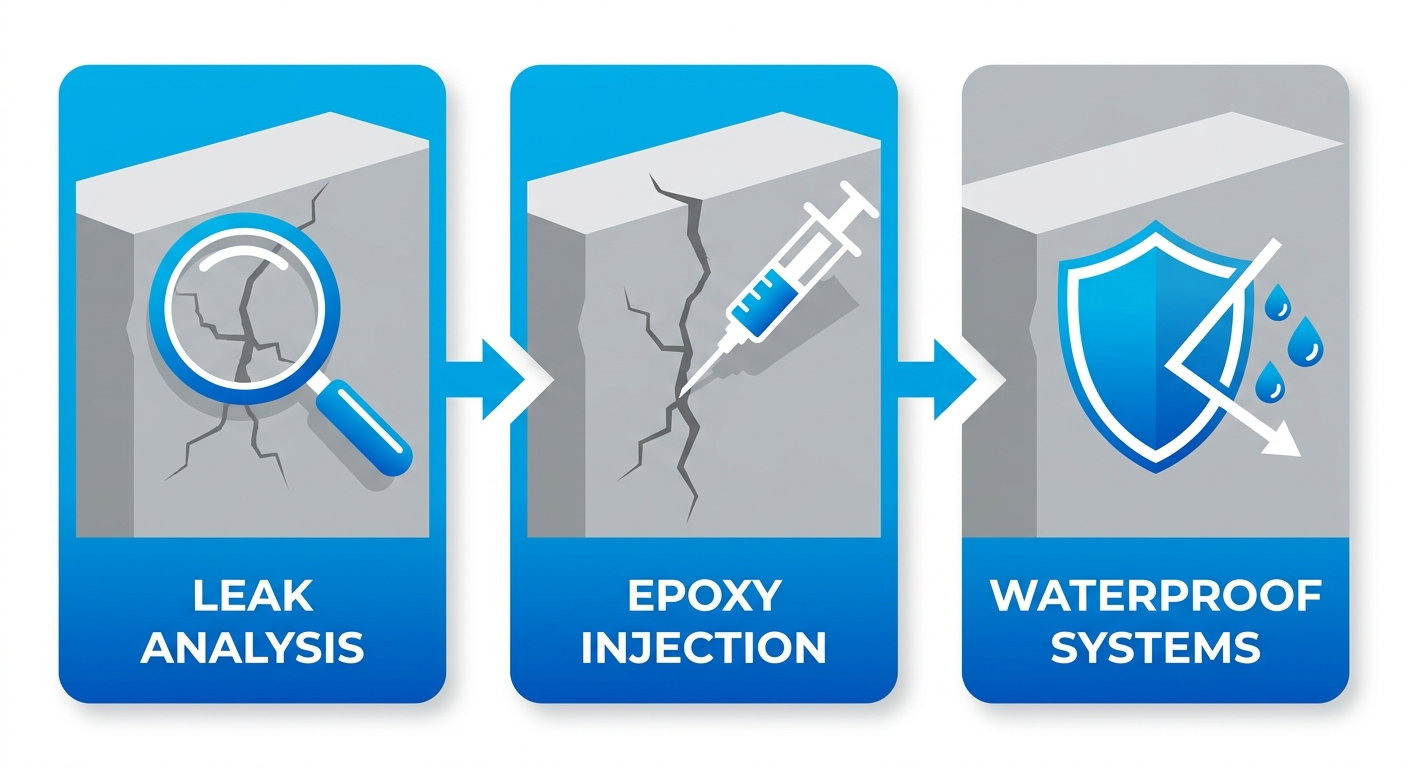
Each phase is designed to identify the root cause of deterioration, restore structural integrity, and protect surfaces against the Bay Area’s damp climate.
Inspection and Leak Analysis for Targeted Repairs
Every repair engagement begins with a detailed condition survey that maps visible distress and hidden moisture pathways. For multi-story buildings in Oakland and San Francisco, we combine moisture-meter mapping with controlled leak testing to pinpoint water entry points, even when staining is not yet visible on interior finishes. This investigative phase isolates whether the source is a failed deck coating, a cracked wall assembly, or an unprotected below-grade surface.
By documenting crack patterns, efflorescence, and differential movement, our team creates a precise repair scope. The analysis identifies which cracks are active or dormant, helping us choose between epoxy injection for structural restoration or elastomeric bridging for flexible waterproofing. This targeted approach eliminates guesswork and ensures that subsequent repairs address the actual cause, not just the symptom.
Per ZFA’s industry guidance, early-stage moisture mapping is critical for determining the appropriate repair strategy in structures exposed to coastal humidity. Without this diagnostic step, even high-quality waterproofing materials can fail prematurely because hidden leaks continue to undermine the substrate. Our condition surveys therefore become the blueprint for the entire restoration sequence.
Application of Epoxy Injection for Structural Cracks
For effective epoxy injection concrete repair, we follow a precise, step-by-step procedure that restores both strength and water-tightness to cracked concrete. The crack is first cleaned of dust, debris, and loose particles to ensure proper adhesion. After surface preparation, injection ports are installed every 6 inches along the crack, with spacing adjusted slightly wider for hairline fissures and closer for wider openings.
When filling vertical cracks, the epoxy is injected under low pressure from the bottom port upward, forcing the resin to fill the entire depth until it emerges at the next port–a method that ensures complete saturation. For horizontal cracks, we sometimes rely on gravity-fed techniques because the material naturally flows into the opening without requiring the same pressure. The injected epoxy cures over 24 to 48 hours, depending on ambient temperature and humidity, forming a bond that is often stronger than the surrounding concrete.
This technique is especially valuable in Bay Area buildings where seismic micro-movements can reopen cracks if only a surface patch is applied. By bonding the crack faces monolithically, epoxy injection provides both structural reinforcement and a seal against water penetration, addressing two critical needs in a single operation.
Waterproofing Systems for Walls and Decks
Once cracks are sealed, the focus shifts to protecting surfaces from future moisture intrusion. For exposed decks subject to Oakland’s fog and rain, we apply elastomeric coatings that remain flexible while offering high UV resistance. These coatings stretch as the concrete thermally expands and contracts, preventing film cracking. For below-grade walls, cementitious systems are used; these create a dense, mineral-based barrier that stands up to constant hydrostatic pressure.
Between-slab waterproofing often calls for sheet-type membranes that isolate individual slabs, especially in multi-story commercial buildings where water migration between floors can damage finishes and create liability. All these systems are backed by waterproofing services San Francisco that ensure the assembly is continuous from deck to below-grade, handling the Bay Area’s unique demands. When waterproofing concrete walls in the Bay Area, we also account for the region’s frequent rain and damp microclimates by extending protection well above grade and detailing all penetrations with flexible sealants.
By combining targeted leak analysis, structural epoxy injection, and layered waterproofing systems, concrete repair in Oakland and throughout the Bay Area becomes a lasting solution rather than a temporary fix. Each step respects the local climate and seismic realities, delivering a restoration that maintains both appearance and function.
Best Practices for Maintaining Concrete and Waterproofing in Oakland
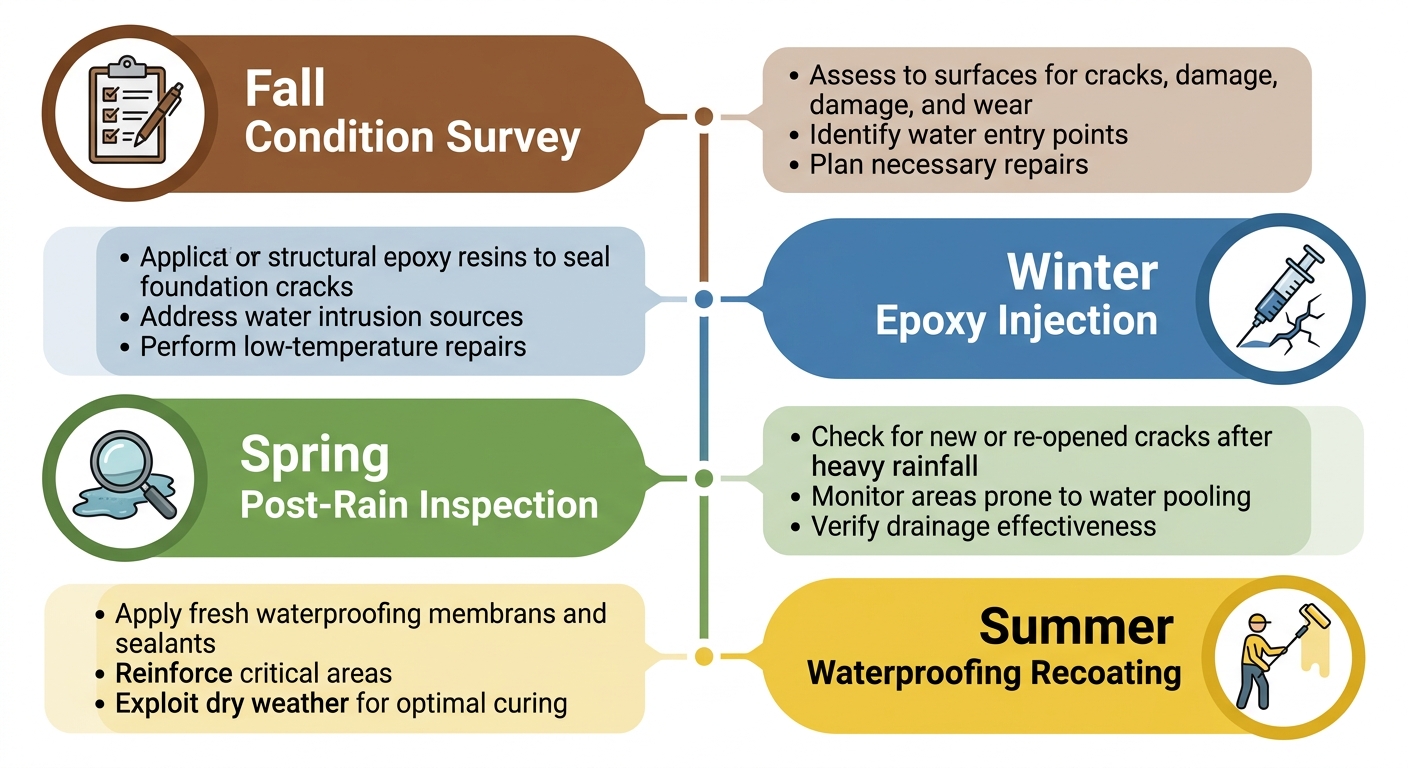
When it comes to concrete repair in Oakland, proactive maintenance is the most cost-effective strategy for protecting your property from the relentless cycles of wet winters and dry summers. Recognizing the signs of damage is only the first step in preserving your investment. Implementing a structured maintenance routine that accounts for the region’s unique seismic stresses and moisture challenges is what ensures long-term durability and prevents minor issues from escalating into major structural failures.
Regular Inspections and Condition Surveys
The foundation of any effective maintenance program is a consistent, professional inspection schedule. Oakland’s Mediterranean climate demands a twice-yearly approach: schedule a comprehensive survey at the end of the dry season in October or November, and a follow-up inspection at the end of the wet season in April or May. This timing allows you to catch damage from summer heat before winter rains arrive and to assess the impact of winter storms before the dry season begins.
During these surveys, a qualified professional will systematically check for early warning signs. They should closely examine concrete for new cracks, surface spalling, or powdery white efflorescence, which signals active water migration. A thorough inspection of all sealants in expansion joints is critical, as failed seals are a primary entry point for moisture. Routine condition surveys should also include a detailed check of existing sidewalk waterproofing concrete repair systems for signs of delamination, pooling water, or failed seals that can compromise the entire assembly. Finally, below-grade walls should be examined for any signs of dampness or active water intrusion, which often go unnoticed until significant damage has occurred.
Choosing the Right Materials and Methods
Once an inspection identifies areas needing attention, the longevity of your repairs depends entirely on choosing products engineered for the Bay Area’s dynamic environment. For the structural repair of cracks, epoxy injection concrete repair is the industry gold standard. These repairs should specify a two-component, moisture-tolerant epoxy that meets ASTM C881 Types I through IV, which can restore the structural integrity of cracked concrete and even exceed its original strength.
For sealing joints and cracks subject to movement, select high-performance sealants that comply with ASTM C920, with a minimum Class 25 movement capability. Systems like SikaFlex polyurethane sealants offer the elasticity needed to accommodate thermal expansion, contraction, and the minor seismic shifts common in the region. This principle of flexibility extends to surface protection. When waterproofing concrete walls in the Bay Area, rigid cementitious coatings are often a poor choice. Instead, elastomeric coatings–such as polyurethane or high-build acrylic-based systems–are recommended for decks, walkways, and walls in high-movement areas. They bridge hairline cracks and tolerate seismic movement without fracturing, maintaining a continuous waterproof barrier.
Coordinating with Local Building Codes and Seismic Standards
Any structural repair or waterproofing project in Oakland must navigate a complex web of state and local regulations designed to protect life and property. All concrete work must adhere to the California Building Code (CBC), specifically the provisions of Chapter 19 governing concrete quality, design, and construction. Furthermore, the seismic vulnerability of existing structures is assessed using the ASCE 41 standard for “Seismic Evaluation and Retrofit of Existing Buildings,” a critical factor given Oakland’s proximity to the Hayward Fault.
This regulatory landscape makes it essential to hire specialists with the correct California contractor licenses, such as C-8 (Concrete), C-33 (Painting & Waterproofing), or B-General, who also have direct experience navigating Oakland’s municipal permit requirements. Coordination is especially vital when waterproofing intersects with a seismic retrofit. New waterproofing applications on structural walls must be designed in tandem with a structural engineer to ensure they do not inadvertently impede a building’s engineered seismic performance. Finally, as a best practice for asset management, maintain a detailed log of every inspection, the specific repair materials used, and the contractor who performed the work. This documentation is a powerful tool for enforcing product warranties, planning future capital improvements, and supporting any future insurance claims, proving that a diligent maintenance protocol was followed.
Securing Long-Term Concrete Integrity in Oakland, California
For reliable concrete repair in Oakland, commercial and residential property owners face ongoing threats from seismic activity along the San Andreas Fault, persistent moisture from Pacific fog, and aging infrastructure. Securing long-term concrete integrity is essential to protect building value and safety.
One proven method is epoxy injection concrete repair, which seals cracks and restores structural strength by preventing water ingress that can weaken reinforcement steel. In tandem, waterproofing concrete walls in the Bay Area is critical to block moisture migration that leads to spalling and corrosion. According to ZFA Structural Engineers, proper crack sealing and moisture management are essential for concrete stability in earthquake-prone regions. These protective measures address the core weaknesses that Oakland’s climate and geology impose on concrete structures, requiring skilled application to ensure long-lasting results. Industry resources consistently recommend integrated waterproofing and crack repair for concrete longevity.
ARC, a local Bay Area contractor, offers comprehensive concrete restoration services including stucco repair, caulking, and between-slab waterproofing that meet Oakland’s building codes and seismic retrofit requirements. With deep regional knowledge, ARC also provides San Francisco structural restoration services throughout the Bay Area. Contact ARC for a consultation on your Oakland property and secure long-term concrete integrity.
Resources
San Francisco
California
94115